What real website value looks like: a Singapore SME case study
A Singapore client compared two routes for the same business - a custom subscription site we'd built, and a higher cost package from a larger agency. The custom site continued to perform better in search, clarity, functionality and overall business usefulness. The takeaway wasn't about who the providers were. It was about what actually creates value in a business website - execution, structure, SEO, and long-term support.
The starting point: an affordable, custom build
The client is a Singapore SME in a service industry. We built their website on our usual subscription model - a small monthly fee for content and social posts, a low monthly fee for hosting and maintenance, and an affordable rate for the integrated AI features. There was no large upfront package and no long lock-in.
It wasn't a brochure site. We built a biodata-style content management system the team could update themselves, structured the pages around the searches their customers actually run, wired up the SEO foundations and structured data, and added the practical features the business relies on day to day. The site was working - ranking steadily on Google, loading fast on mobile, and matching what the business actually does.
Exploring a higher cost option
The client later explored a more expensive package from a larger agency. That's a normal thing for an SME owner to do. A bigger provider, a more polished pitch, and a grant story together create a strong impression of safety and professionalism - and those signals matter when you're committing real money to your online presence.
None of that is unreasonable on the owner's side. When you're not a developer, the easiest signals to read are price, brand size, and grant support. They're not wrong signals. They're just incomplete ones, because they don't tell you anything about how the finished site will actually perform once it's live.
What the two sites looked like in practice
Search rankingThe custom subscription site continued to outrank the alternative for the keywords that matter to the business - the searches that actually drive enquiries and revenue.
Business messagingThe custom site read clearly as the specific business it represents, with concrete services, pricing posture, and proof points. Coherent messaging helps both customers and search engines.
Functional depthThe custom build supported real workflows the team actually uses - structured records, search-friendly pages built around customer intent, and the small operational details that make a site useful.
Long-term careThe subscription model meant the site kept improving every month - new pages, content updates, SEO refinements and technical maintenance - rather than going stale after launch.
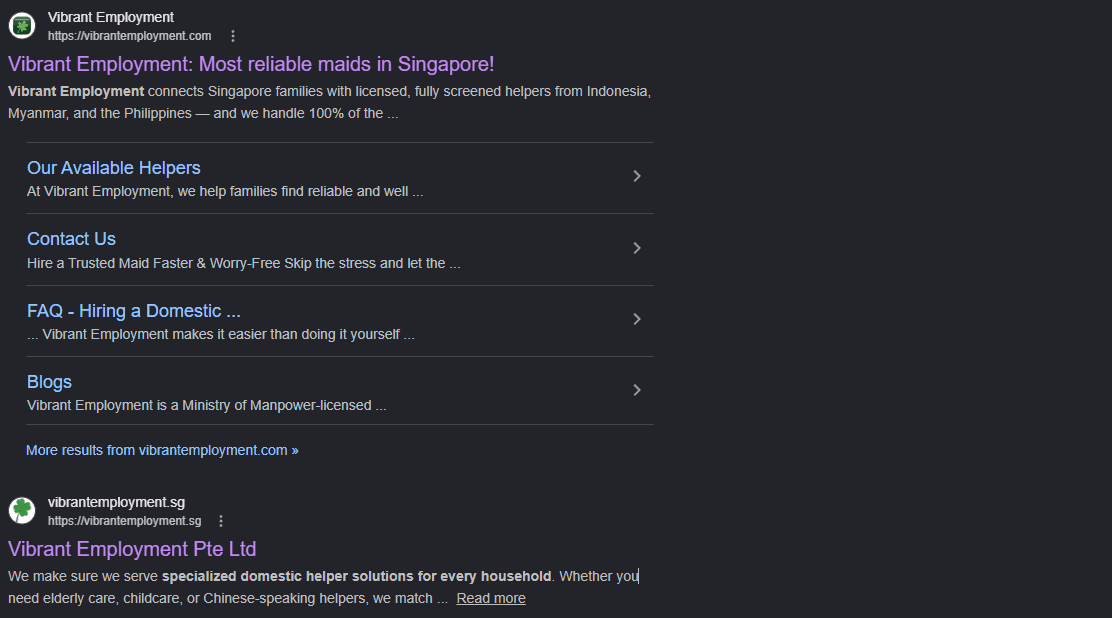
What's underneath that ranking difference
Search ranking isn't decided on visual appeal. It's decided on what Google can actually read about a page. One of the clearest signals is structured data - the machine-readable markup that tells search engines what kind of business the site represents, where it operates, who it serves, and what reviews and credentials back it up.
Google publishes a free tool that makes this visible. The Rich Results Test shows exactly what structured data Google can detect on any URL. It's the kind of check that takes thirty seconds, and it tells you a lot about how carefully a site has been built underneath the visual layer. Run both URLs through it and the difference is immediate.
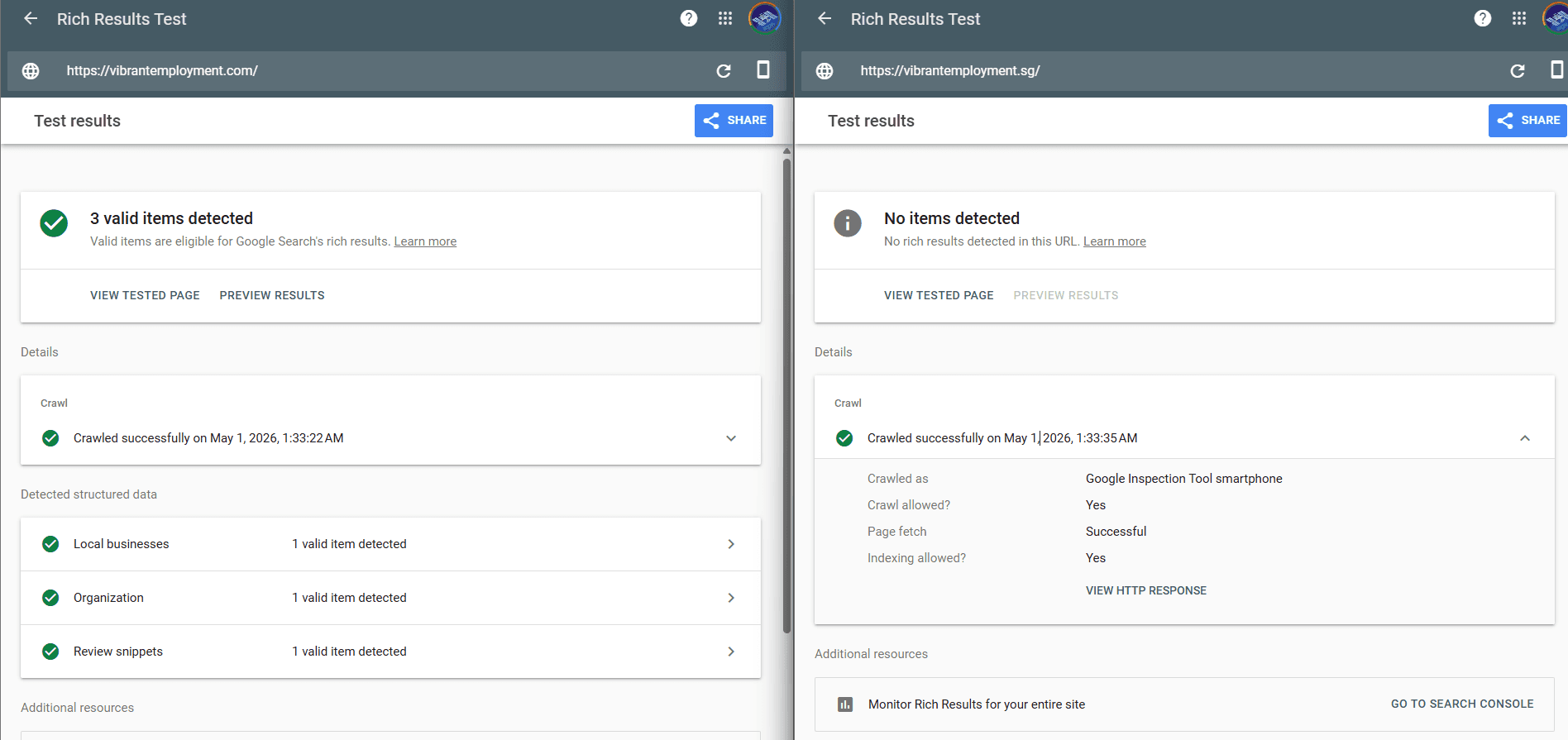
Invisible to owners, decisive to Google
This is the kind of gap an owner can't see by eye. Both sites look fine to a visitor. But to Google, one is clearly identifying itself as a Singapore service business with reviews and an organizational structure, and the other is essentially silent at the structured-data layer. That silence is part of what shows up later as a weaker ranking, weaker click-through rate, and fewer enquiries.
Structured data isn't the whole story either. Page speed, semantic HTML, internal linking, mobile rendering, sitemap hygiene, indexability, crawl budget - there are a dozen quiet signals that decide how a site performs in search. A good build gets them right by default. A polished-looking template can miss most of them and still “look fine” from the outside.
Why this happens so often
Most SME owners aren't technical, and they shouldn't have to be. The things that actually decide whether a website performs - SEO structure, site architecture, conversion quality, hidden template content, technical maintenance, backend functionality, real enquiry attribution - all sit below the surface, in places a non-developer can't easily inspect.
So owners reasonably fall back on the signals they can read. A confident pitch from a larger agency tends to land four impressions all at once: “this is safer”, “this is more professional”, “this is more official”, “this must be better because it costs more”. None of those instincts are wrong - they're just incomplete, because they don't say anything about how the finished site will actually perform once it's live.
That's why technically stronger work can lose to a more polished pitch. Not because owners are doing anything wrong, but because the technical work is essentially invisible to them. When you can't see what's working, it's natural to lean on what feels safe.
What this reinforced for us
Real website value isn't about agency size or price tag. It's about execution, structure, SEO, and long-term support. A bigger budget can buy a more polished launch, but it doesn't automatically buy better search rankings, clearer messaging, or features that match how the business actually operates.
Businesses don't just need websites that look polished. They need websites that are coherent, trustworthy, searchable, and useful. Those four words do more for an SME's online performance than any visual upgrade on its own.
And good web development isn't about who's biggest. It's about whether the finished site actually serves the business - in search results, in customer enquiries, in day-to-day operations, and in how it grows over time.
What SME owners can look for
Search performance, not screenshotsAsk to see how the developer's previous sites rank on Google for the keywords those clients care about. Visual mockups don't pay the bills - search visibility does.
Coherence with your businessRead the site's pages out loud. Do they sound like your business, or could they belong to anyone? Specific, coherent content tends to convert and rank better than generic copy.
Page speed and structureFree tools like PageSpeed Insights show Core Web Vitals and structured data quality. Strong scores indicate care taken at build time. Weak scores show up in both rankings and bounce rate.
What happens after launchA website is a living asset, not a finished poster. Ask what ongoing care looks like - updates, SEO, monitoring, content - and how it's priced. That's often where real value compounds.
Making the value visible (the bigger lesson on our side)
The most useful lesson from all of this wasn't “agencies sometimes win pitches”. It was that ongoing value has to be made visible to clients every month, not just delivered quietly in the background. When a client only sees “website hosting” or “monthly fee” on an invoice, the work behind it becomes easy to underestimate - and easier to switch away from when a louder pitch arrives.
Visibility isn't about being defensive. It's about giving owners the information they need to evaluate their digital presence properly - in business terms, not technical jargon. Done well, it's genuinely useful for the client and it makes good work harder to mistake for “just hosting”.
What that looks like month to month
Ranking & traffic reportsWhere the site sits on Google for the keywords that bring in real enquiries, who's visiting, and which pages and channels are doing the work - trended over time so the picture is honest.
Enquiry trackingCalls, form submissions and WhatsApp clicks attributed back to the pages and campaigns that drove them, so the website can be measured in customers, not just clicks.
SEO improvementsTechnical fixes, content updates, structured data and internal linking - the layered work that compounds into stronger rankings month after month.
Features deliveredNew pages, sections, integrations and improvements shipped in the period - concrete deliverables, not just “ongoing work”.
Maintenance summaryUpdates, security patches, uptime, page-speed tuning - the unglamorous care that quietly protects the site every month.
Business impactTying the technical numbers back to what owners actually care about: enquiries, customers, revenue, and where to double down next.
How we approach this at Web Wizards
We build business websites that are structured for trust, search visibility, and real customer action - not just visual appeal. Our strength is combining clean design, SEO-conscious content, and practical business features into sites that actually support day-to-day operations.
The subscription model is part of that. Instead of a large one-time package, we work with clients on an ongoing basis - the site keeps improving, the SEO keeps compounding, and we have to keep proving our worth month after month. That accountability is the point.
And we make the work visible. Rankings, traffic, enquiries, features shipped, SEO improvements and maintenance - reported in plain English, on a regular cadence. So the value of the engagement is something owners can read for themselves, not something they have to take on faith.
Finally, we recommend the right solution, not the most expensive one. Sometimes that's a clean, content-led site. Sometimes it's a full-stack platform with custom workflows. The brief should fit the business, not the other way around.
Curious why we work on subscription instead of one-time packages? Why we offer subscription-based website and SEO services covers the reasoning and the trade-offs in detail.
Comparing platforms before you commission? Custom React vs WordPress changes what's possible on speed, security, and structured data - custom code vs WordPress.
Want a website that actually performs - not just one that looks the part?
Tell us about your business, your customers, and how you'd like to be found online. We'll map out a website plan that's structured for search, built around real customer action, and supported month after month so the value keeps compounding.